A New Benjamin Miles Mystery. Buy it here (Paper or Kindle)
Follow Miles to California where he investigates Golden Eagles and wind farms.
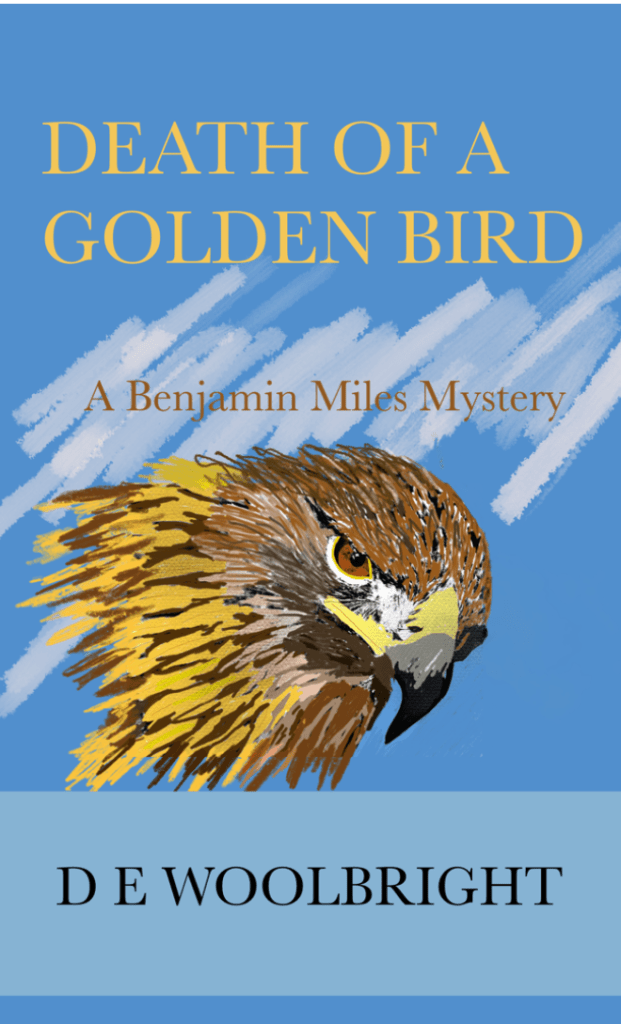
Death of a Golden Bird
Prologue
Outside Livermore, the Chevy Silverado pulled off the interstate and drove for several miles on the old state highway before turning onto a gravel road that serviced the three-armed behemoths standing watch. The service road followed the contours of the land—gentle, rolling, treeless hills—and was paralleled by a chain-link fence, topped with barbed wire and posted with no-trespassing signs to welcome the occasional stray traveler. The truck drove several more miles, then slowed and pulled over at an entrance gate that was chained shut. The driver reached for a bolt cutter beside him on the seat, got out, walked up to the gate, and proceeded to lop off the chain. He left the truck door open: the subwoofer was thumping out a bass line that shook the ground with a relentless monotony. The driver returned and eased the truck through the gate, got out of the cab again, and threaded the chain through the fence links, tying it loosely in a knot before continuing on his way.
Minutes later, he arrived at his hilltop destination. A footpath beside the truck wandered off toward the distant behemoths. He retrieved a black canvas backpack and a walking stick from behind the driver’s seat. The trip had been carefully planned so that he would arrive at sundown. He would have less than an hour to finish the job before it was full dark. The headlights of the truck flashed briefly when he locked the doors. He paused to survey the rolling hills. A group of wind turbines stood at attention in the distance—tireless soldiers stretching over the horizon in neatly aligned rows and columns. Even at this distance, the machines produced a low-level hum that was off-putting. The young man headed out, following a desultory path through the hills on his way to the nearest turbine.
It is difficult for a passing motorist to gauge the size of a wind turbine. They exist as distant curiosities—casually observed objects standing apart in some treeless plain or on some mountaintop. As objects in isolation, they are incomparable. Up close, this particular tower loomed as large as an ancient redwood. The steps at the base led to a metal doorway, and two hundred feet above that, perched on top, was the nacelle which housed the gearbox and generator. It was the size of a two-car garage.
Beneath the tower, the young man could feel the steady turbulence generated by the spinning arms as he paced away from the base and dropped the backpack on the ground. He removed two latex gloves and put them on, snapping each one into place with a flourish. After removing the camera and hanging it around his neck, he began to circle the tower, methodically scanning the ground in a search for dead birds. When the first circuit was complete, he moved the bag ten paces further away from the base and set out on a second concentric path. Working in this fashion he moved further and further away from the turbine.
There were lots of dead birds.
After photographing each one, the young man would make an entry in a small notepad that he kept in his front shirt pocket. Twice, he stooped over to retrieve a dead bird and to put the remains in a plastic bag which he placed into the black canvas backpack. Most of the dead birds were left undisturbed. Scattered among the birds were lots of dead bats, but the young man ignored all of them.
Two of the large birds he discovered were raptors – a mature red kite and a young golden eagle – both had been struck down by the giant arms. The kite had not died immediately. It bore the wounds of an animal attack that had finished the job after the bird had first been injured. It was an opportunistic kill by a predator living along the path of the wind farm. The kite’s carcass was at once striking and horrific. After making several notes, the young man took some photos and moved on.
The golden eagle’s wing had been crushed by a turbine arm, snapping it at an awkward angle. The bird had fallen and died where it had landed. After photographing the bird where it lay, the young man lifted the bird for a closer look. He carefully folded its fractured wing back into place. He pulled the bird closer and stared into its face, and then began rubbing its head like you might caress the family dog. The golden eagle’s head alone was worth three hundred dollars on the black market. A wing, even a broken one, would also sell for several hundred. The tail feathers and talons would each bring a few hundred more. He removed his cell phone from his back pocket and took several selfies while holding the bird. It was almost dark now, and the phone flashed automatically each time he took a picture, revealing his presence under the turbine. When he was satisfied, he pocketed the phone and replaced the bird where it had fallen. He took several additional photos and jotted down another entry in the notebook.
He had completed three circuits around the turbine when he was interrupted by a single gunshot that struck the backpack directly, knocking it away from his feet, and leaving a neat hole in the canvas. He stared down incredulously at the hole in the bag, and then realizing the danger, ducked and turned to look for the gunman. There was no one there. He scanned the hills. The only movements were the lights of cars on the distant interstate. Where was the shooter? A second shot, and another bullet struck the backpack, turning it over, and the young man began to run, abandoning the bag where it sat. He searched for cover but there was none. A third shot rang out and he felt the bullet whiz past overhead. All he could do was run. He ran until he was panting, his lungs ached, and his heart hurt, and when he could run no further, he fell down and hugged the ground. He did not want to die. The images of the dead golden eagle and the pitiful kite came into his mind, and he was afraid to move or make a sound. He just stayed put. Frozen. It was much later when the moon had begun to rise, illuminating the hills and his position there, that he decided to make an escape. He moved cautiously through the hills, taking his time, and eventually found his truck. The windshield and rear window had been smashed. When he opened the door, the dead eagle and the canvas bag were together on the seat. He pushed the bird onto the floorboard and got in. The engine cranked on the first try.
The truck crashed through the entrance gate without slowing down, snapping the chain like a string. The young man did not stop again until he was back home in Davis.
 Punctilious Publishing